Showing posts with label saints. Show all posts

Friday, February 13, 2009

Saint of the Week -- Absalom Jones

Absalom Jones was the first African-American priest in the Episcopal Church. His saint's day, which falls within Black History Month, is often a cause for particular celebration in our church. Our diocesan celebration of Absalom Jones Day is this Sunday at 3 p.m., at Christ Church-Detroit.

Jones was born into slavery in Delaware in 1746, and was later sold to a store owner in Philadelphia. While still a slave, he married Mary King, and saved to purchase her freedom first, so that their children could be born free. Jones did not purchase his own freedom until he was 38.

Along with Richard Allen, Jones led a movement of African-Americans out of the Methodist church where they had been worshipping. Tired of being relegated to upper galleries and treated like second-class members, Jones and Allen took their compatriots out of the white church and established churches for their own people.

The church Absalom Jones established, St. Thomas's African Church in Philadelphia, petitioned to become an Episcopal parish. Jones was ordained a deacon in 1795 and a priest in 1804. For his entire life, Jones worked and spoke and prayed for an end to slavery, and for more decent treatment of slaves and freed Africans.

(Richard Allen established his church within the Methodist tradition, founding the African Methodist Episcopal -- AME -- denomination.)

Sunday, January 18, 2009

The Story of the Black National Anthem

Yes, you did see Chaplain Sarah and me in tears today as we sang the closing hymn, "Lift Every Voice and Sing." This hymn has long been known as the "Negro National Anthem," or the "Black National Anthem." It was sung daily in black schools, immediately following the reciting of the Pledge of Allegiance.

The song was written in the year 1900 by the African-American poet James Weldon Johnson and was set to music by his brother J. Rosamond Johnson, for a celebration of Lincoln's birthday. In his autobiography, Weldon wrote of the song's composition that he paced back and forth on the front porch of his house, repeating the lines of the song over and over to himself in an agony of creation. When he came up with these two lines -- Sing a song, full of the faith that the dark past has taught us./Sing a song, full of the hope that the present has brought us--he wrote that was when the spirit of the poem came full upon him.

So much has happened in the intervening 108 years since this song was written. So much has happened in my own life time. On this weekend when we honor Dr. Martin Luther King, Jr., and on Tuesday, when King's dream becomes reality as Barack Obama takes the oath of office and becomes our president -- the song just hit me. I thought of all those children in all those schools singing this song day after day in a world that offered them little hope for the future. I thought of Dr. King and his persistent leadership and witness. And I thought of our new president, a man elected not for the color of his skin, but for the content of his character.

The man who wrote this song, the people who have sung it over the generations, believed in the promise of our nation, trusted that the rule of law would prevail, that the Bill of Rights applied to everyone. Their faith has not been in vain.

Thank God!

+ Kit

(The photo above is a statue called "The Harp" by Augusta Savage. It is her visual representation of "Lift Every Voice and Sing.")

Friday, December 26, 2008

The Second Day of Christmas -- Feast of St. Stephen

Because most folks do not run off to church every day during the 12 days of Christmas, we miss a compelling understory that runs through this season of bowl games and parties, travel and relaxation. The understory is a dark one. The church calendar marks people and events that reflect the struggles and violence of the world that Christ came to save.

Today, the "two turtledove" day in the 12 Days of Christmas carol, commemorates the church's first martyr, Stephen, the deacon. He confronted the religious authorities in Jerusalem with his witness to Jesus Christ and was stoned to death for his comments. A young man named Saul, the future St. Paul, was a bystander.

The feast of Stephen is also noted in the carol "Good King Wenceslas" about a poor man looking for firewood on a bitter winter night in the 10th century. The Bohemian king, Wenceslas, decides to take his page out to find the man, build a fire and serve him dinner. The king and page fight through the bitter snow, and the page almost gives up the trek. The king tells him to step within his footprints ... and his feet are so warm that they melt the snow right down to the ground. This was one of the miracles that made the historical king, Saint Wenceslas I, a revered saint almost from the instant of his death.


It ends with a cry for this season, one we forget in our celebrations: "Therefore Christian men be sure, wealth or rank possessing/Ye who now will bless the poor, shall yourselves find blessing."

Where do you find someone struggling outside your doorstep today? Where do you see someone willing to die for their convictions? What does it mean to you that the Christmas season encompasses martyrdom and mercy, testimony and courage?

+ Kit

Saturday, November 22, 2008

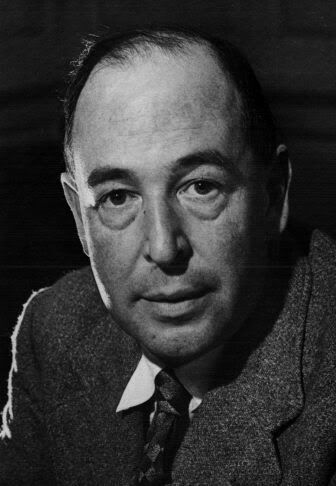
Saint of the Week -- C.S. Lewis

Today we celebrate Clive Staples Lewis, author and apologist for the Christian faith. Born in Belfast, Northern Ireland, in 1898, Lewis had a lonely childhood. His father was emotionally distant, and his mother died when he was ten. A series of boarding schools, some nightmarish, some merely horrid, formed him, until he left for Oxford. A rich fantasy life, especially focused on the Norse myths, sustained him.

After serving in World War I, he kept a promise made to a fellow soldier, that if anything happened to one of them, the other would care for the family left behind. After his friend Paddy Moore died, Lewis took Paddy's mother, Jane, as his adopted mother. Eventually, in 1930, Lewis, his brother Warnie, Jane and her daughter Maureen moved into "The Kilns", the famous house outside Oxford where Lewis wrote the bulk of his work.

Lewis lapsed into atheism in his teens, and was reluctantly converted -- first to a sort of theism, then eventually to Christianity. He remained a loyal Anglican, to the dismay of his friend J.R.R. Tolkein, who had hoped Lewis would become a Catholic.

In Lewis's later life, he met Joy Davidman Gresham, an American divorcee who had corresponded with him. He entered into a civil marriage with her, but after she developed bone cancer, he realized the depth of his love for her, and a Christian marriage was performed at her hospital bedside in 1956. Gresham's cancer went into remission and she and Lewis lived together for four more years. His grief at her eventual death fueled the writing of A Grief Observed, a raw and painfully honest look at the loss of a beloved.

I treasure Lewis most for the Narnia books ... a series of children's stories set in the imaginary land of Narnia. While they lack the intellectual heft and subtlety of Tolkein's Lord of the Rings series, Narnia melds Lewis's imaginative and painful childhood with the beauty and confidence of his faith. As a middle aged man, "Jack" Lewis managed to awaken his own inner child to write classics that children and adults alike return to, over and over again.

Lewis died on November 22, 1963. News of his death was completely overshadowed by the news of President Kennedy's assassination.

+ Kit

Thursday, August 28, 2008

Saint of the Week -- Augustine of Hippo

In May, we celebrated Saint Monnica, mother of Augustine. Now at last we have arrived at the saint day of her son.

It is hard to estimate the influence of this one North African bishop on Christianity. Augustine gave us way too much to think about on the topic of original sin, an outgrowth of his lifelong struggle against lust (we still have a theological hangover from his work on original sin). He also gave us the just war theory, which teaches us not so much whether or not to enter conflict, but what is an ethical way of conducting one's part in the conflict. As Rome fell to barbarian invaders, he wrote the massive City of God, which explained how the Church, the "city of God" would eventually win out over human empires -- "the cities of men."

Augustine was a Berber, not a Roman, an outsider, a genius rhetorician, a wild and crazy guy, who after years of resisting his mother's prayers and the grace of God, gave in. He heard a child in a garden singing, "Take and read, take and read." He picked up the Letter to the Romans (which has gotten more people riled up for Jesus than any other book in the Bible ... like Martin Luther and John Wesley for starters.) and was converted.

"Thou hast made us for Thyself," he wrote later in his Confessions, "And our hearts are restless until they rest in thee."

+ Kit

Thursday, July 17, 2008

Saint of the Week -- Bishop William White

We have William White to thank for so much. For the survival of the Anglican faith in the United States following the Revolutionary War. For the democratic structure of The Episcopal Church. For the insistence on democratic election of bishops by clergy and lay people combined. I suppose we might even thank him for Gene Robinson. Or the existence of the Anglican Communion.

Rev. William White, an Anglican clergyman, was one of the very few clerics in the Church of England to support the Revolutionary War. He was chaplain to the Continental Congress from 1777 to 1789, and then served as chaplain to the U.S. Senate. Anglicanism in America almost died out after the Revolution -- after all, if England was no longer in charge, what place was there for the Church of England? The number of Anglicans in the U.S. dwindled after the war to only about 10,000 members as clergy and Loyalists fled to Canada or England. Churches sat empty across the colonies. It looked like Anglicanism would perish in the new nation.

There had been no Anglican bishops in the colonies because church leaders did not want to give the colonial church that much independence and power. So the first order of business to preserve Anglicanism was to get some bishops. Samuel Seabury was the first U.S. bishop, and he was ordained in Scotland, where he would not have to take an oath swearing allegiance to the King. In 1787, William White of Pennsylvania and Samuel Provoost of New York traveled to England and were consecrated there under a new British law providing for Anglian churches in countries not ruled by England.

It then remained to create an American Anglican church. The church was named The Protestant Episcopal Church in the United States of America (to get anything even sounding like British authority out of the title). Episcopal comes from the Greek word for bishop, which showed that this would be a hierarchical church under the authority of diocesan bishops. This was the first church outside the United Kingdom to be in relationship and communion with the Church of England. It was, you might say, the beginning of the Anglican Communion.

William White established the governance of our church ... including election of bishops by clergy and lay people in a diocese. "The power of electing a superior order of ministers ought to be in the clergy and laity together, they being both interested in the choice," White wrote. (In most of the Communion, bishops are not elected, but appointed. This causes much confusion as the U.S. church tries to explain how it is that New Hampshire ended up with a gay bishop. Because the church in New Hampshire -- clergy and lay delegates -- VOTED for him!) He made sure the voices and opinions of lay people would be heard on vestries, in diocesan conventions and at the triennial General Convention of the church.

In this month when we celebrate our nation's independence from Great Britain, and when bishops from all over the Anglican Communion are gathering in England for the Lambeth Conference, it is appropriate for us to honor and celebrate dear Bishop William White, who made it possible for us to have a church that is representative of all its people, while still maintaining the ancient orders and authority of bishops, priests and deacons.

Friday, June 27, 2008

Saint of the Week -- Irenaeus of Lyon

St. Irenaeus lived in the Lyon area of what is now France in the second century. He survived the persecutions under the emperor Marcus Aurelius, but he is best known for writing his mammoth work Against Heresies refuting Gnosticism.

This work was the main source for everything we knew about Gnosticism until the Nag Hammadi scrolls were found late in the last century. Irenaeus asserted the importance of bishops, of the long stream of tradition dating back to the apostles, and the authority of Scripture. The New Testament was not finalized yet, and Irenaeus argued for the reliability of the four gospels as four different and authoritative pictures of the life of Jesus.

Irenaeus helped to shape the church, the New Testament, and the future of Christianity. He is a "Father of the Church" in the Roman Catholic tradition.

+ Kit

Friday, June 13, 2008

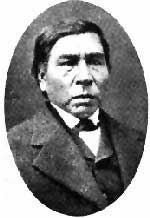
Saint of the Week -- Enmegahbowh

Enmegahbowh was the first Native American to be ordained a priest in the Episcopal Church. His name means "He who prays (for his people) while standing."

Enmegahbowh was an Odawa native from Canada, who joined an Ojibwa tribe in Minnesota. James Lloyd Breck started a mission there in 1851, and Enmegahbowh was trained and baptized by him. Enmegahbowh was ordained and took over a mission in Crow Wing, Minnesota, in 1851.

Enmegahbowh was a man of peace, working to bring reconciliation between the Native Americans and the United States. As his people were moved from reservation to reservation, he traveled with them, providing leadership and spiritual support. On June 12, 1902, he died at age 95 at the White Earth Indian Reservation in northern Minnesota.

Thursday, June 5, 2008

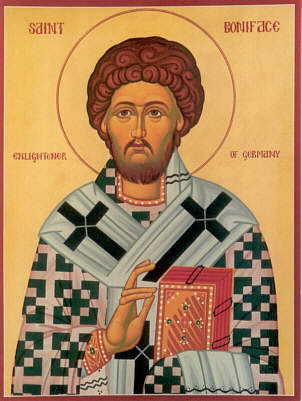
Saint of the Week -- Boniface

Boniface was born in England around 675, with the given name of Winfred. It wasn't until he went to Rome to get approval from Pope Gregory to become a missionary that he got his new name. Gregory sent him to evangelize Germany and gave him the name Boniface. He worked the rest of his life in Germany, establishing Christianity, becoming a bishop, then archbishop of Mainz.

He retired his office in 753 and went back to his missionary work. On June 5, 754, he and his companions were murdered by a band of pagans as he waited for a group of converts to arrive for confirmation.

Thursday, May 22, 2008

Saint of the Week -- Jackson Kemper

No, he's not the founder of an insurance company. Jackson Kemper, whose saint's day is on Saturday, was the first missionary bishop in the Episcopal Church.

In 1835, General Convention made all the members of the Episcopal Church members also of the Domestic and Foreign Missionary Society (this is still the legal name under which the church is incorporated -- we are all members of a missionary society.) It provided at the same time for missionary bishops to go into the wilderness. Jackson Kemper was the first such bishop.

Consecrated shortly after this decision in 1835, Kemper immediately headed west. He was assigned to Missouri and Indiana, but also planted churches in Iowa, Wisconsin, Minnesota, Nebraska and Kansas. He had a hard time finding missionaries to join him in his ministry -- most Episcopal clergymen came from plush, well-to-do Eastern families and they could not handle the harsh Midwestern conditions.

Kemper also cared for the native Americans under his care, urging translation of our services into more native languages, and respecting their cultures and traditions.

How are you following in Kemper's footsteps this week as a missionary to the Midwest?

Wednesday, May 7, 2008

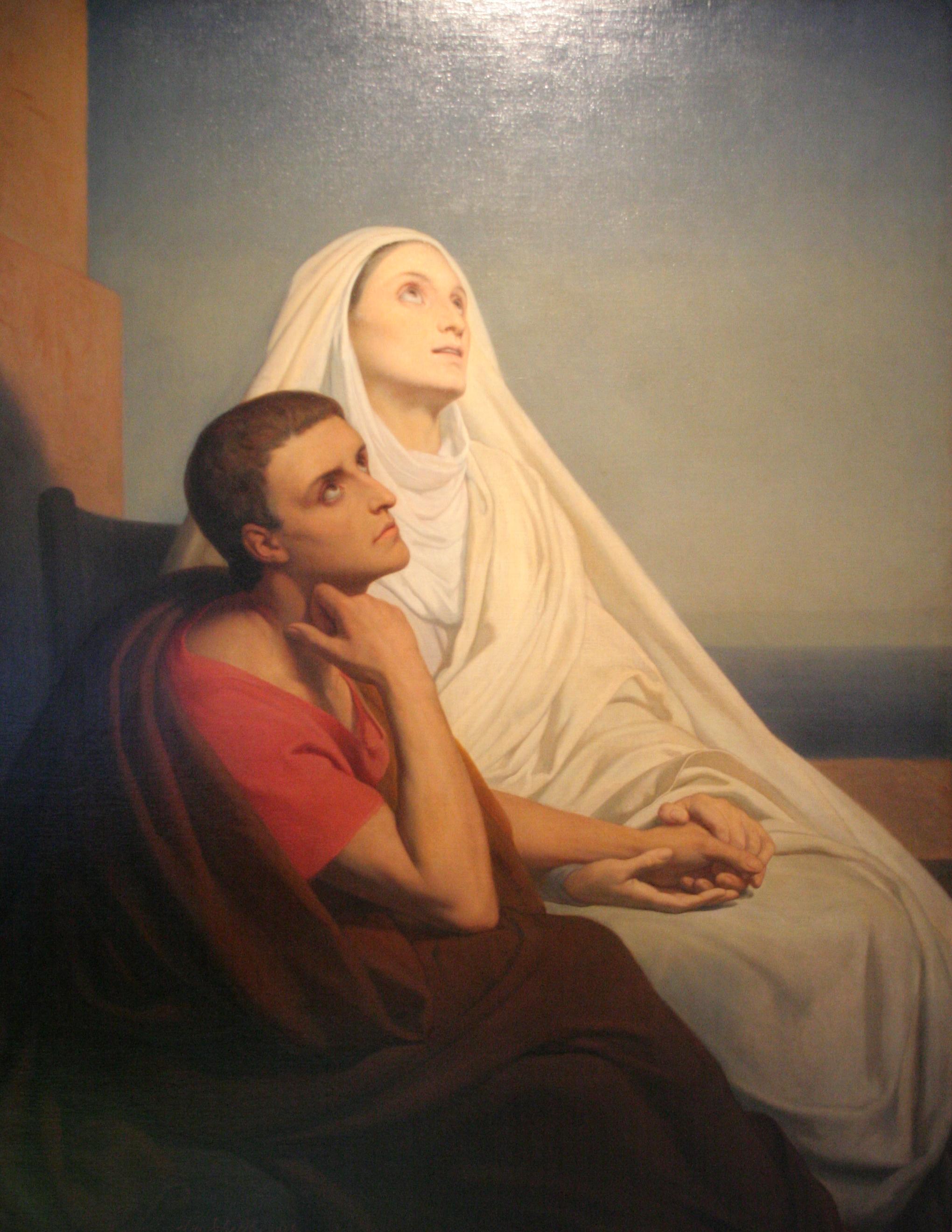
Saint of the Week -- Monnica, Mother of Augustine


I always think of Monnica as the patron saint of mothers with wayward sons who don't live up to their full potential ... at least for a while.

Monnica was the mother of St. Augustine, one of the greatest theologians of Christianity. But Augustine wasn't always so saintly, and his mother -- a seriously devoted Christian woman of North Africa -- was crazy with worry about him. He lived a life of debauchery. He had a mistress and an illegitimate child. He was brilliant and a stellar rhetorician, but he espoused a heresy called Manichaeism.

So Monnica fasted and prayed and wept and prayed for her son. She sent him to a bishop to see if the bishop could get him to see the light of Christ. No luck. But the bishop told Monnica not to give up, that "It is impossible that the son of so many tears should perish."

Augustine's famous conversion is told in his "Confessions." Shortly after his baptism, he was taking his mother home to Africa, but she died in Ostia, an Italian port. She died serenely happy. Her work here on earth was done. She was asked if she was afraid to die in a foreign country. She replied, "Nothing is far from God, and I have no fear that he will not know where to find me, when he comes to raise me to life at the end of the world."

Her son would go on to lead the church during the Fall of Rome, and to write great works like "The City of God" that would shape Christian thought and faith forever.

+Kit

Wednesday, April 30, 2008

Saint of the Week -- Catherine of Siena

Scholastic philosopher, theologian, tireless worker for the unity of the church, counselor to popes, kings and queens, fearless nurse to lepers -- Catherine of Siena lived an amazingly fruitful life in her short 33 years.

Born the 23rd of 25 children (the 24th, her twin sister, died in infancy), Catherine was always intended to marry. Her father, a cloth-dyer, was part of the political party that ran Siena. An advantageous marriage would help his business and his political career.

But at the age of 7, Catherine had a vision of Jesus and dedicated her virginity to Christ. And she meant it. She resisted every attempt on the part of her parents to be a normal Italian Renaissance girl. She flogged herself, fasted, slept on a board, and cut off her golden hair in defiance of her parents. In turn, they made her the family slave for three years, hoping a life of Cinderella drudgery would break her spirit.

But Catherine merely made a prayer room in her own heart and kept on communing with God. Eventually, her parents relented. She became a third order Dominican, which allowed her to live at home. After three years in silent prayer in a room in her family home, she emerged at age 19 with a call to serve the world.

In the 14 years of her public ministry, Catherine nursed lepers and cancer victims. She studied the ancient texts and scriptures, and gathered a community of followers to work for the purification of the church. She traveled to Avignon, France, where the Pope was living under control of the King of France and lectured the Pope and harangued him until he returned to Rome. She was never shy about speaking truth to power, and wrote similar letters to kings and queens all over Europe, urging them to greater holiness.

A life of ascetic abuse and anorexia doomed her to an early death, and she died in Rome in late April, 1380. Her body is buried in Rome, but the people of Siena, knowing she would want to be buried in her hometown, removed her head and spirited it home, where it is entombed in the Basilica of San Domingo.

In the Roman Catholic church, she is the patron saint of firefighters, nurses, people mocked for their piety, Italy (along with Francis of Assisi), and television.

Television? Go fig.

Friday, April 25, 2008

Saint of the Week -- Mark the Evangelist


Mark the Evangelist is shrouded in the mists of the Bible and history. He is traditionally thought to be a companion of Peter, a person who heard Peter's stories about Jesus and recorded them at a later date. He is also linked to the Mark mentioned in Acts who travels briefly with Paul and Barnabas. Tradition holds that he went to Alexandria after Peter's death, and there in Alexandria, he was martyred.

Although we know little about the biography of the man Mark, he has left us a most astounding legacy. His Gospel According to Mark is the first gospel ever to be written; he created a whole new literary genre from scratch. His story of the life and ministry and death and resurrection of Jesus forms the core of the other Synoptic Gospels, Matthew and Luke.

Mark's gospel is brief, to the point, and should be read, as someone I once heard say, "With the throttle of your imagination wide open." Yet for all its brevity, it is filled with power, grace, and with a singular focus on the Messianic Secret: namely that the only way to really know Jesus as Messiah is to discover him on the cross.

So on this feast day of St. Mark the Evangelist, why not dip into that first gospel, and "Read, mark (or rather Read Mark), learn and inwardly digest" it?

Wednesday, April 9, 2008

Saint of the Week -- Dietrich Bonhoeffer


Dietrich Bonhoeffer (February 4, 1906-April 9, 1945) is best known for his resistence to the Nazi regime. He was a leader in the Confessing Church movement in Nazi Germany -- the Protestant resistance to the regime. He considered taking refuge in America, but in 1942, returned to Germany to continue the resistance.

In 1944, he took part in a conspiracy to assassinate Hitler and was executed for it in 1945. For someone who had preached non-violent resistance his whole career, it was a significant shift for him to consider a violent end to Hitler's life. But he believed that not to try to stop Hitler, even violently, was the greater evil.

His greatest work, The Cost of Discipleship teaches us how to take the Christian life and journey seriously, laying aside our attachment to worldly things and following Christ alone.

Christianity stands or falls with its revolutionary protest against violence, arbitrariness and pride of power and with its plea for the weak. Christians are doing too little to make these points clear rather than too much. Christendom adjusts itself far too easily to the worship of power. Christians should give more offense, shock the world far more, than they are doing now. Christians should take a stronger stand in favor of the weak rather than considering first the possible right of the strong. -- Bonhoeffer, Sermon on II Cor. 12:9

Friday, April 4, 2008

Saint of the Week -- Martin Luther King, Jr.

Although he was a Baptist preacher, Martin Luther King, Jr., is remembered in Lesser Feasts and Fasts, the calendar of Episcopal saints. In the Episcopal church, saints are recognized for the virtue of the life they lived on earth.

Also, as in most traditions that honor saints, the “saint’s day” to be observed is the day of the person’s death, the day that marks the end of their temporal life, the day they enter into eternal rest in God.

So although we often acknowledge Dr. King on the Sunday nearest his birthday, it is appropriate, on this the 40th anniversary of his martyrdom, to remember him today.

Early morning, April four
Shot rings out in the Memphis sky.
Free at last, they took your life
They could not take your pride.

In the name of love
What more in the name of love.
In the name of love
What more in the name of love.


This is a lovely version of U2's "Pride" covered by John Legend. Excuse the History Channel advertising aspect of it.